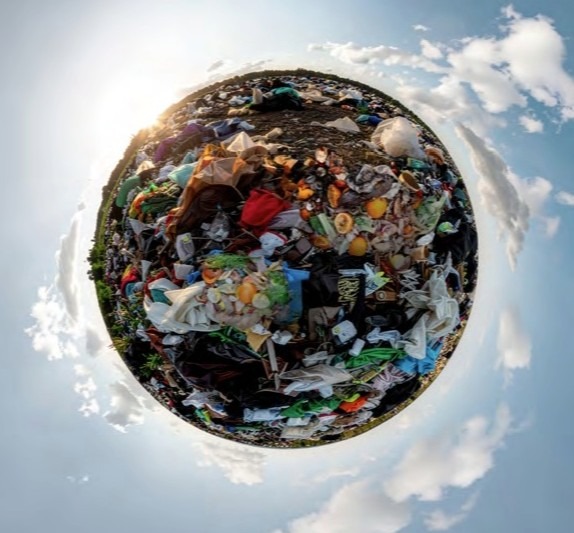
Shooting in the Gulf or for the Moon may currently be more exciting but the age – old problem of what to do with the World’s unbelievable amounts of rubbish is still with us. Kudos, then, to the World Bank for What A Waste 3.0, its latest “global snapshot of solid waste management towards circularity until 2050”.
MSW comprises mainly food (45% in East Asia and the Pacific) but also paper (10%), plastics (13%), Waste Electrical and Electronic Equipment (WEEE) (2%) and lots of other stuff, each often needing to be collected and / or treated differently. MSW does not include other major sources of rubbish such as that from construction and demolition (C&D) – how do you dispose of an entire building?!
In its 384 pages, the report contains an impressive amount of data (HK produces an estimated 2.19 kg per person per year compared to Singapore’s 0.89) and plenty of projections showing how the problem is getting worse. The options as to what to do about it are well established – composting, recycling, incineration / waste to energy (WtE), pioneering projects such as HK’s WEEE park or plain old landfill. But the report is light on how to finance these options.
Fortunately, Logie Group is here to help.
The fundamental problem is that, despite the old Yorkshire saying that where there’s muck there’s brass, there is not enough brass in solid waste which is typically managed by local authorities – which can do only so much themselves when they remain constrained for funds and which are rarely creditworthy meaning that they cannot enter into long term contracts with Private Sector Proponents (PSPs) looking to build / operate the necessary processing facilities. In the case of a WtE plant for example, the PSP typically takes performance risk on the local authority delivering the agreed volumes (and mix) of MSW as well as credit risk on the local authority paying both the user fees for taking delivery of that MSW and paying for the power generated from burning the MSW if this is sold back to the local authority.
(Tangentially, Yorkshire has a Day, each 1 August, which this year will be celebrated in Goole. It’s important to stay informed.)
Local authorities can only be made creditworthy by being allowed to stand on their own feet and proving themselves which is unlikely to happen any time soon – or with central government support.
But, as I wrote for the UNECE in 2022, central government support is also finite so it needs to be rationed, allocated and structured so as to be, yes, recycled in ways that are almost never explored but which I looked at whilst advising the MoF in Indonesia a while back. And it should be used to incentivise “good behaviour” as I was involved in at the ADB when disbursing Infrastructure Reform Sector Development Project loans, also to Indonesia.
By all means, negotiate a model transaction then replicate it, especially if the projects are relatively small as they will be here and consolidate projects with identical structures into a portfolio so as to make a bigger deal and spread the risk (both long – held aspirations of the market) but the key, appropriately, is how to recycle the central government support. Once a project has shown that it can stand on its own feet by, for example, earning acceptable debt cover ratios in the opening years of operation, then the support for that project can have been structured to fall away and used to support the next project. And the risk should be shared because this is not a guarantee. (Governments need to monitor how such contingent obligations accumulate even if they run their accounts on a cash basis.) As projects prove themselves and particularly the local financing markets get comfortable with the risk profile, then less and less central government support need be offered (as happened in South Korea) and, in turn, more projects catalysed.
With the right structuring, it can be done. It needs to be done.